2025 - What a year!
Published: Sat 27 December 2025
What a year.
In 2025, we shipped 20 releases, more than double last year's 8 all with substantial features and fixes. We did this with an extremely small team and along the way we tripled our number of paying customers.
We don't have investors. We don't take Venture Capital. Peergos is a non-profit funded directly by the people who use it, customers and donations, which keeps us focused on building what users actually need. If you value a privacy-first, lock-in-free humane web, you can support our work by creating an account.
Version 1.0 and Major features
This year marked a major milestone: Peergos 1.0
Alongside it, we shipped:
- Native desktop apps (Windows, macOS, Linux)
- A full-featured Android app
- A high-performance sync engine
- Post-quantum secure sharing
- Easy server migration
- Massive performance improvements across the filesystem and p2p stack
Let's hear more about each of these.
Sync: Fast, secure and bandwidth-efficient
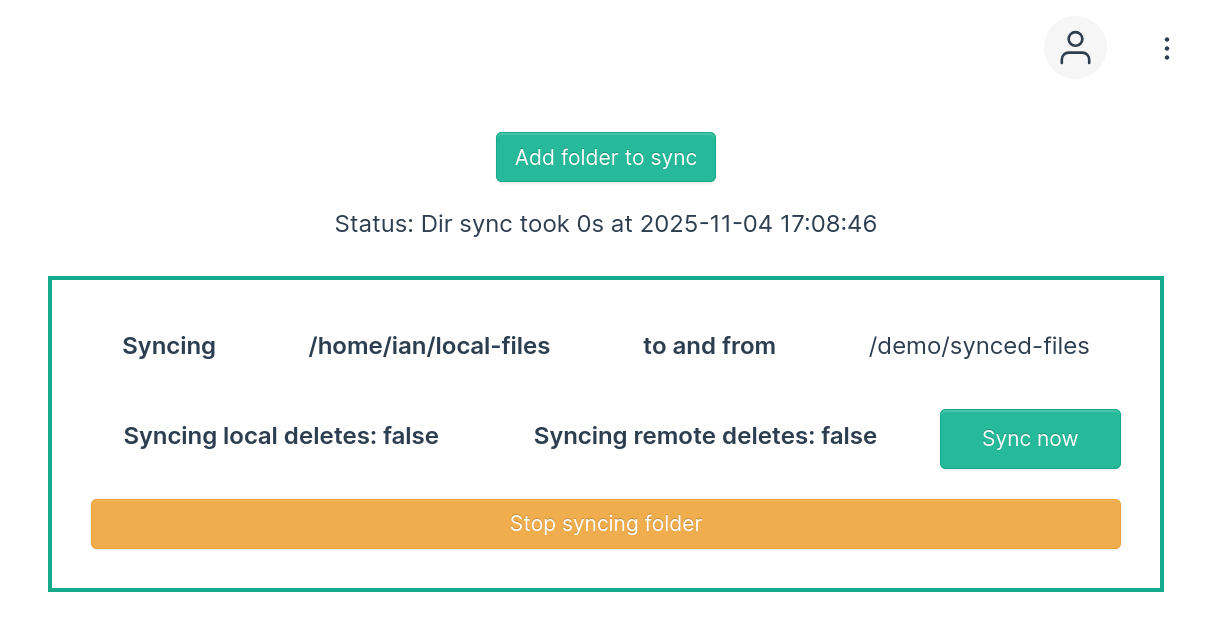
Our biggest new feature this year was the sync engine, now available in the desktop and Android apps. It lets you:
- Keep a local folder fully in sync with a folder in Peergos
- Sync multiple devices to the same remote folder
- Choose whether deletes propagate (turning sync into a backup)
It is efficient, so that if you have a big file synced and you modify a small section of it then it will only upload the modified chunk(s). To enable this and reduce bandwidth required in other situations we added some new encrypted metadata to files - a tree hash. For now this is a custom tree hash based on sha256, in the future we will switch to blake3 once browser support is better. This tree hash allows us to efficiently determine if a local and remote file are the same and also to detect which chunks changed between two versions of a file.
 Security by design
The sync engine operates on a write capability limited to the synced folder. Even if a device is compromised, no other Peergos data is exposed.
On Android, sync runs without the dangerous MANAGE_EXTERNAL_STORAGE permission. Instead, we use the modern Storage Access Framework, giving users fine-grained control without sacrificing full bi-directional sync of any file type.
Native Desktop apps (no Java required)
We released native installers for Windows, macOS and Linux:
This removes the need for Java and enables deeper system integration, including sync. It also improves the threat model: a compromised server cannot deliver a compromised client unlike a web app.
Each platform had its own challenges: Windows CLI needing a separate binary, MacOS signing and notarization, Linux portability, but the result is a cleaner, safer and more capable desktop experience.
Android
The Android app has been our most popular addition. You can install it from Google play or side-loading. It supports the full user interface plus bi-directional sync. Next year we'll be integrating it with the native Android filesystem allowing you to send files directly between Peergos and other apps.
Post quantum
We've upgraded sharing in Peergos to use a hybrid key-exchange based on Curve25519 and MLKEM-1024. This means that anything you share in Peergos is safe against a harvest now, decrypt later attack from a future large-scale quantum computer.
50-150x Faster folder loading
Previously, loading a folder in Peergos required listing all the child capabilities and then retrieving the metadata for each child before anything could be shown in the UI. We introduced a bulk champ.get call which allows us to retrieve up to 20 children in a single request. Then we added more metadata to the directory entries, specifically the mimetype, creation date and whether it is a directory. This means we can populate the UI as soon as we have listed the capabilities and update it with thumbnails and modification times asynchronously in the background. This last change made the UI about 100x faster on high latency connections. Now we can load a folder with 25,000 children from a server on another continent in 29s.
We can still improve this further in the future by parallelising listing the directory capabilities, which currently need (number of children)/500 requests in series. By using the same "stream-secret" technique we use to enable zero I/O seeking within huge files we can make all those requests in parallel and thus only a single roundtrip to the server, regardless of directory size.
Towards a CRDT
We now have automatic concurrent modification handling in most circumstances. Previously, if you uploaded a file whilst editing a totally unrelated file, then saving the changes would result in a concurrent modification exception from the server. Now we handle these automatically if there isn't a genuine conflict, i.e. a concurrent change to the same file or dir. In the future we will also handle non conflicting changes to the same dir. The plan for files is to support CRDT formats like automerge which can automatically merge in concurrent changes.
Shared page
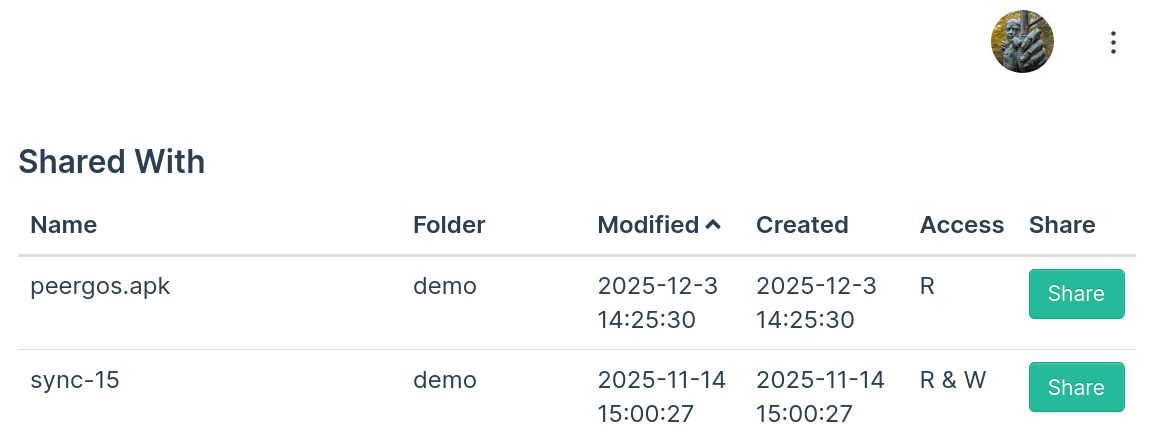
There is a new shared page available in the left sidebar which shows all the things you have shared with others, making permissions and visibility much easier to manage.
Built-in migration and mirroring support
Peergos was designed from day one to avoid lock-in.
Your identity, data and social graph are portable.
This year we made it incredibly easy to mirror your data on another server or migrate to it. With a few clicks you can request or pay for space on another server to start mirroring your data or completely migrate there.
Quic
As part of a grant early in the year, we implemented the quic secure transport upstream in jvm-libp2p. This is now enabled in Peergos and improves reachability of nodes and also resolution and speed of the DHT.
P2P improvements
We fixed some bugs in the p2p http request implementation which makes them much more reliable now. We have also removed all usage of bitswap for retrieving blocks - we just use a standard p2p http request.
Server-side scalability
We've done a lot of work on speed and scalability of garbage collection on large blockstores. Now a garbage collection on a 10 TiB remote S3 blockstore can run in under an hour. We are currently working on another huge speed up to this by segregating the blockstore by user.
The rest
We've added translation for French, Spanish and Polish. There have also been lots of fixes, new mimetype support and CLI improvements.
Looking ahead
2025 was about native apps, ecurity and performance.
2026 will be about polish, usability, iOS and deeper OS integration, while staying true to our principles: privacy, portability and user control.
If that resonates with you, create an account or support our work and help shape what comes next.
Here’s to an even better 2026.
RECENT POSTS
- 2025 - What a year!
- Decentralization Matters
- Security audit 2024
- Reasons to prefer blake3 over sha256
- A better web
- Markdown browser
- Release the BATs (block level access control in IPFS)
- Encrypted email storage and client
- Decentralized encrypted chat
- Peergos launches decentralized & encrypted social media
- Private and customizable profiles
- Simple decentralized web hosting on Peergos
- Encrypted shareable calendar
- Fast Encrypted File Search
- Private Planning Boards in Peergos
- How to solve the social dilemma and fix social media
- Peergos wins EU Next Generation Internet grant
- Direct S3 access
- Peergos release v0.3.0
- Keybase has left the building
- The perfect social network
- Atomic access control
- Peergos release v0.1.3
- Applications on Peergos
- Fast seeking and encrypted history
- IPFS Camp, new features
- Alpha Release
- Security Audit
- Development update